Teaching Children to Pray for Friends: Catholic Prayer Activity

One of the things I love most about teaching children is finding ways to help them put their faith into practice. We can talk about kindness, compassion, and loving our neighbors, but I also want children to experience what those things look like in everyday life.
Recently, I put together a prayer book activity for the third- through fifth-grade children in our Catholic homeschool co-op. Each child would write a personal prayer request, share it with their classmates, and receive a little book filled with their friends’ prayer intentions.
My hope was that the children would take those books home and spend a few minutes now and then praying for one another.
What I didn’t expect was how much I would appreciate the process of making the books themselves, or how encouraging it would be to see what happened afterward.
Teaching Children to Pray for Others
As Catholics, we teach our children to pray from a young age. They learn the Our Father, the Hail Mary, the Glory Be, and the prayers we say together at Mass.
But I also want children to understand that prayer isn’t limited to memorized words or asking God for things they need themselves.
We can pray for other people. We can ask God to help someone who is struggling, comfort someone who is sad, or give a friend the courage to do something difficult.
This is called intercessory prayer, and it’s something I want our children to understand and practice.
When children pray for their friends, they begin to recognize that the people around them have their own worries, hopes, struggles, and needs. They learn that loving someone includes praying for them.
Our Catholic Prayer Book Activity
I called our activity Thank You, God, for My Friends.
Discussing What We Can Pray For
Before the children began writing, we spent time talking about the different things a person might ask others to pray for.
I wanted them to understand that prayer requests don’t have to be about something terrible happening. We can ask God to help us grow in patience, become more courageous, treat others kindly, or strengthen our faith.
We discussed the Beatitudes and everyday virtues, and read through examples of prayer intentions inspired by both.
Some of the prayer ideas included:
- Help me have a cheerful heart.
- Help me be patient with others.
- Help me speak kindly to my family and friends.
- Help me be brave when trying something new.
- Help me forgive others when they hurt my feelings.
- Help me do what is right, even when it is difficult.
- Help me trust God when I am worried.
- Help me be thankful for the blessings in my life.
The children could choose one of the examples or write something entirely their own.
I wanted them to think about their own hearts and what they might need God’s help with, without feeling pressured to share anything too personal.
Why I Had the Children Write Their Prayer Requests Over and Over
One part of this activity was particularly important to me.
Rather than having each child write a prayer request once and then making copies for everyone, I had them write their own prayer intention separately for each of their classmates.
In our group, that meant writing the same request six times.
I know that might sound repetitive, but that was part of the point.
I wanted the children to spend time thinking about what they were asking God for. Writing something once can be quick. Writing it six times requires a little more attention.
Each time they wrote their request, they were reminded of something they wanted to work on, something they hoped for, or an area where they needed God’s help.
For example, a child who wrote, “Dear God, please help me be more patient,” had to return to that same thought several times.
It gave them an opportunity to reflect on their intention rather than simply filling out a card and moving on.
And because each card was going to a different classmate, they were also personally asking six friends to remember them in prayer.
I really liked that part of the activity.
Putting the Prayer Books Together
Once everyone finished writing and coloring their prayer cards, we cut them apart and exchanged them.
Each child gave one of their prayer cards to every other child in the class. Then we assembled the cards into small booklets.
Each book contained the prayer intentions of that child’s classmates, along with an opening prayer:
A Prayer for My Friends
In the name of the Father, and of the Son, and of the Holy Spirit. Amen.
Dear God,
thank You for my friends.
Hear the prayers they have shared.
Help me remember them in prayer
and love them through my actions.
Bring us closer to You.
Through Christ our Lord.
Amen.
The children also had space inside the back cover to draw something they were thankful for.
The finished books were small enough to keep on a bedside table, tuck into a prayer corner, or carry along to co-op. I wanted them to be something the children would actually use.

How to Make the Prayer Books With Your Own Group
The activity is simple to organize, and you don’t need many supplies.
We used printable prayer cards and covers, regular printer paper, cardstock for sturdier covers, crayons or colored pencils, scissors, and a stapler.
Our finished books measured approximately 4¼ × 5½ inches, or one-quarter of a standard sheet of letter-size paper.
Here’s how we organized the activity:
- Discuss prayer intentions. Read through examples and help the children think about what they would like their friends to pray for.
- Write the prayer requests. Have each child write the same personal intention on a separate card for every other child in their group.
- Color and decorate. Give the children time to personalize their prayer cards and booklet covers.
- Cut and exchange the cards. Each child gives one completed prayer card to every other child.
- Assemble the books. Stack each child’s collected prayer cards between the covers and staple twice along the left edge. An adult should handle the stapling.
- Encourage the children to use them. Explain that they can take their books home and pray for their classmates whenever they have a few minutes.
The entire lesson took us approximately one hour, including our discussion, writing, coloring, cutting, exchanging cards, and assembling the books.
What About Larger Classes?
We had seven children participating, which worked especially well because each child only needed to write six prayer requests.
For a larger CCD class or Catholic school classroom, I would divide the children into smaller groups of approximately five to seven.
That way, they still get the experience of writing their intentions several times without having to write the same request 19 or 20 times.
Each child would then make a prayer book containing the intentions of the other children in their smaller group.
Encouraging Children to Keep Praying After the Activity
Making the prayer books was only the beginning.
I didn’t want this to be another craft that the children enjoyed for an afternoon and then forgot about.
After we sent the books home, I encouraged the parents to help their children find them and spend a few minutes praying for their classmates.
Even two minutes would be a wonderful start.
And I was careful about how often I reminded the parents. I certainly didn’t want to pester anyone or turn something meaningful into another obligation on an already busy family’s list.
But I also know how easily things get misplaced in a house full of children, schoolbooks, and activities. Sometimes a little reminder is all it takes.
At one point, I sent the families another message because I had been encouraged by what I was seeing.
I told them that I had it on good authority that prayers from the children’s prayer books were being answered!
I wasn’t trying to pressure anyone. I simply wanted to encourage the children to keep praying for one another.
When You Begin to See Those Prayers Answered
I want to share one little example that has stayed with me.
One of the children had asked their classmates to pray that they would become braver and less afraid to do things.
Later, I watched that child do something in front of others that took real courage.
Knowing what the child had asked their classmates to pray for made that moment especially meaningful to me.
Of course, I don’t know every little step that led up to it, or exactly how God was working in that child’s life.
But I believe prayer matters. I believe God hears our prayers, even when the answers don’t come in the ways or on the timelines we expect.
And that experience encouraged me to keep reminding the children to pray for one another.
Making Prayer for Friends a Regular Habit
I don’t think this needs to become an elaborate family project. Keeping it simple makes it much more likely that children will continue doing it.
A prayer book can be kept beside a child’s bed, near a family prayer space, or wherever they usually say their prayers.
A parent might occasionally ask, “Have you prayed for any of your friends lately?” or suggest picking up the book before bedtime.
Children could pray for one classmate each night or read through the entire book when they have a few extra minutes.
They can also add their own prayers as new needs arise.
And when they hear that a friend’s circumstances have changed, they can thank God, continue praying, or ask how else they might pray for that person.
I wouldn’t want children to think prayer is a transaction, where we ask God for something and expect Him to give us exactly what we requested. Sometimes our prayers are answered differently than we hoped, and sometimes we have to wait.
But I do want them to know that their prayers are worthwhile and that God invites us to bring our concerns to Him.
Make Your Own Catholic Prayer Books for Friends
I enjoyed this activity enough that I made the printable prayer book available for other Catholic families, homeschool co-ops, and religious education classes. It is now available as a digital download in the Here They Grow Etsy shop.
Thank You, God, for My Friends includes prayer-request cards, child-friendly prayer ideas based on the Beatitudes and everyday virtues, printable booklet covers, and instructions for assembling the books.
The idea is to let each child write a personal prayer intention and share it with the other children in their group. By the end of the activity, everyone has a small prayer book filled with requests from their friends.
You can use it with a homeschool group, CCD class, Catholic school classroom, or even a small group of siblings and friends.
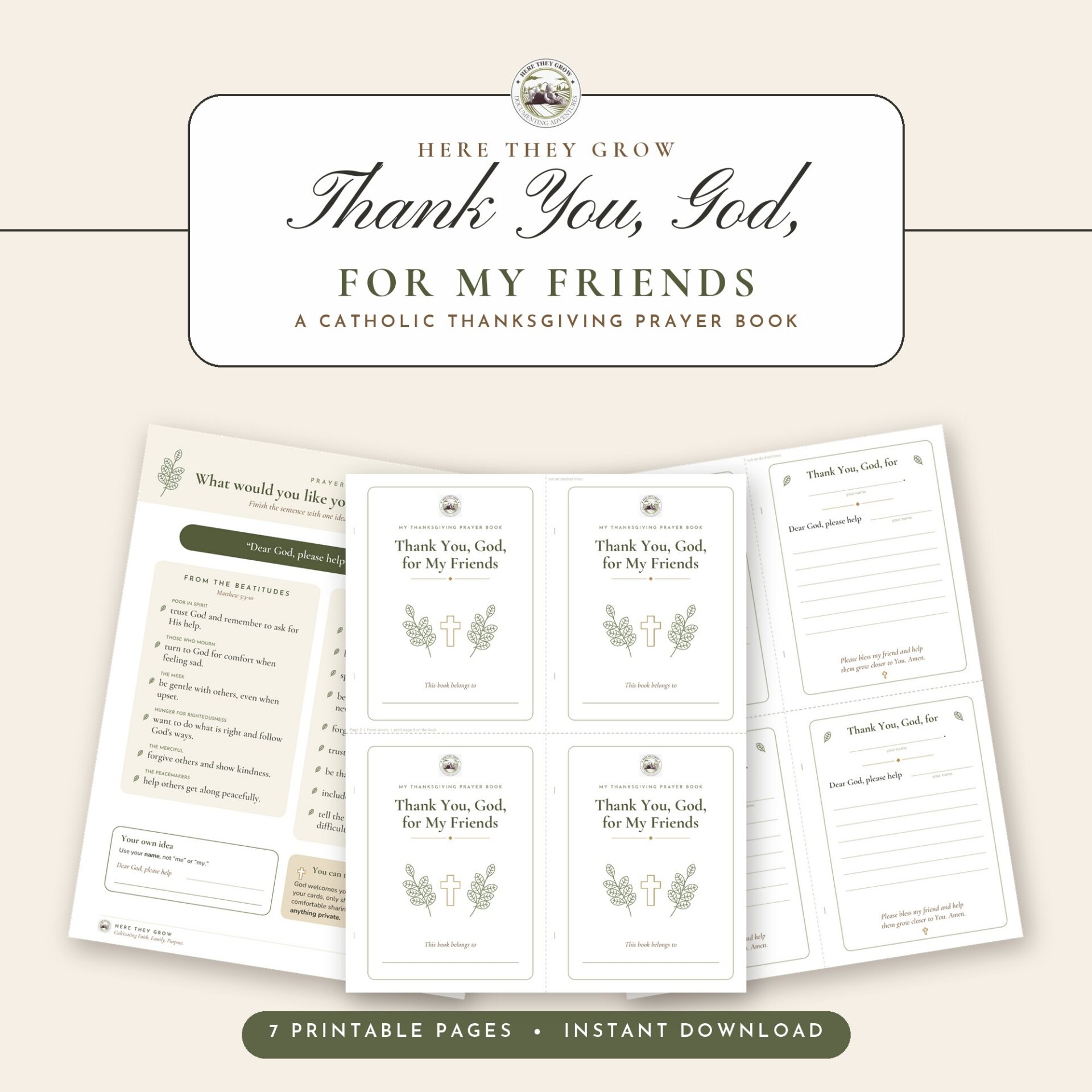
Here They Grow Printable
Thank You, God, for My Friends
A seven-page Catholic prayer book activity created to help children pray for their friends and practice intercessory prayer together.
The complete seven-page printable is available now as a digital download in the Here They Grow Etsy shop.
Get the Printable on EtsyI hope other children enjoy making these books as much as ours did, but more than that, I hope they continue using them long after the activity is finished.
A Little Encouragement to Keep Praying
I don’t know how often the children in our class have opened their prayer books since we made them. Some may be using them regularly, while others may need a reminder to find them again.
But I do know they took time to consider their own prayer intentions, wrote them out for their friends, and went home with the opportunity to pray for one another.
I hope that as they grow, they’ll remember that praying for someone is one of the ways we can show love.
We may not always see how God is answering those prayers, but we can keep praying anyway.
Have you ever done a prayer activity with your children or students that stayed with them long after the lesson? I’d love to hear about it.
Frequently Asked Questions
Catholic Prayer Book Activity FAQ
What is intercessory prayer for children?
Intercessory prayer means praying for another person. In this activity, children practice bringing their friends’ needs, hopes, and intentions to God.
What ages is this prayer activity best for?
We used the activity with third- through fifth-grade children in our Catholic homeschool co-op.
How long does the prayer book activity take?
Our group completed the discussion, writing, coloring, cutting, card exchange, and booklet assembly in approximately one hour.
How many children should be in each group?
Our group had seven children. For a larger CCD class or Catholic school classroom, groups of approximately five to seven keep the repeated handwriting manageable.
What supplies are needed?
The activity uses printable prayer cards and covers, regular printer paper, cardstock for sturdier covers, crayons or colored pencils, scissors, and a stapler.
You May Also Like:
 Creating a Cozy, Faith-Filled Christmas at Home: Traditions That Help Our Family Slow Down
 How We Celebrate October as a Family Before the Holiday Rush
 Weekly Challenge #31: Say “Thank You” at Least Three Times a Day
 Why We’re Beginning Latin in Our Homeschool
 Camp Made Me Realize Something About Public School Moms (and Myself)
 The Best-Friend Lens: A Simple Tool for Purposeful, Family-Centered Parenting
 Cozy Thanksgiving Traditions: How We Create a Peaceful Holiday Season at Home
 Raising Communicators: Why We’re Prioritizing Language in Our Homeschool