Why We’re Beginning Latin in Our Homeschool
Homeschooling, language learning, and classical education
We are beginning Latin in our homeschool this year, and the more I look at what the children can gain from studying it, the more I understand why Latin has held a place in education for so long. As with many parts of our homeschool, I keep coming back to how one subject often supports many others. That is something I have also seen in why we chose homeschooling, in the way extracurriculars can support core subjects, and in the long-term value of teaching children how to think through problems.
We are using Memoria Press Latin. I originally became familiar with the program because several seasoned homeschool moms whose opinions I trust recommended it to me over the years. Now that we are ready to add Latin to our school day, it seemed like a good place to begin.
In this post
Table of Contents
Why We’re Learning Latin
Latin can sound like an extra subject, something to add if there happens to be room in the schedule. I see it differently. There are so many places where Latin supports things the children are already learning and will continue to learn as they get older.
A tremendous amount of English vocabulary has Latin roots, particularly the more advanced vocabulary students encounter in literature, science, medicine, law, history, and theology.
Once children begin recognizing those roots, unfamiliar words are not always completely unfamiliar anymore. They may recognize a piece of the word, understand where it came from, and have a better chance of working out what it means.
Latin also gives children a very deliberate introduction to grammar. They have to pay attention to nouns, verbs, adjectives, endings, and the role each word is playing in a sentence. I like the idea of grammar becoming something they actually understand rather than simply a set of rules they use without thinking much about them.
Latin starts as its own subject, but before long you begin noticing it everywhere else.
Latin in Science, Plants, and Birding
One of the things I especially like is how often Latin appears in the natural sciences.
Plants, animals, and other living things are identified scientifically using Latin or Latinized names. Common names can vary by region and language, but scientific names give people studying the natural world a much more precise way to identify a particular species.
You see this with plants all the time. Garden centers, seed catalogs, and gardening books often include the scientific name alongside the familiar name of a plant. The same is true in biology and nature study.
It also shows up in birding. Bird guides commonly include scientific names along with common names. The American Robin is Turdus migratorius, the Northern Cardinal is Cardinalis cardinalis, and the Eastern Bluebird is Sialia sialis.
I am certainly not teaching Latin so the children can memorize the scientific names of every bird or plant they encounter. I do like knowing that when they see this terminology in a bird guide, gardening book, nature study, or biology course, it will not seem quite so foreign.
That is one of the things I find interesting about Latin. It starts as its own subject, but then you begin noticing it everywhere else.
Latin as a Foundation for Language Learning
This is probably the part that interests me most.
Spanish, French, Italian, Portuguese, and Romanian developed from Latin. English is not a Romance language, but a significant amount of English vocabulary comes from Latin, either directly or through languages such as French.
Studying Latin gives children practice looking closely at how words are formed and how languages relate to one another.
They begin noticing roots, prefixes, suffixes, and word endings. Instead of seeing every unfamiliar word as something completely new to memorize, they can begin recognizing patterns and relationships between words.
I do not expect Latin to somehow make every other language easy. I do think understanding how a language is constructed can be very helpful when learning another one. It gives children another framework for thinking about vocabulary and grammar rather than simply memorizing words and phrases.
A Few Things Latin Can Support
- Vocabulary growth and word analysis
- Grammar awareness
- Science and nature study terminology
- The study of Romance languages
- History, theology, law, and classical literature
Why We Chose Memoria Press Latin
I have been hearing about Memoria Press Latin for years. Several seasoned homeschool moms whose opinions I trust have recommended it to me at different times. It was not just one person or one conversation. The name kept coming up.
So when we decided it was time to start Latin, Memoria Press was already on my mind.
I wanted the children to actually learn the language, not just memorize a few Latin words and prayers. I like that the program builds from vocabulary and basic grammar into more serious Latin as they get older. I also like knowing that there is a clear path forward rather than having to figure out what comes next every year.
We are just getting started, so I am not going to review a curriculum we have not used long enough to really know yet. I will come back and do that after we have some experience with it.
For now, I can tell you why I chose it: homeschool moms with a lot more years of experience than I have recommended Memoria Press Latin to me more than once. Sometimes that is a pretty good place to start. That same kind of thoughtful planning is part of why I care about intentional learning and contribution-focused childhood rhythms and how they shape our children over time.
Helpful Printables and Language Activities
As we add Latin to our homeschool rhythm, I also like having simple printable tools nearby for language practice, reading, reporting, planning, and daily learning routines. Printable resources can help children stay organized while giving parents something easy to use without adding more preparation to the day.
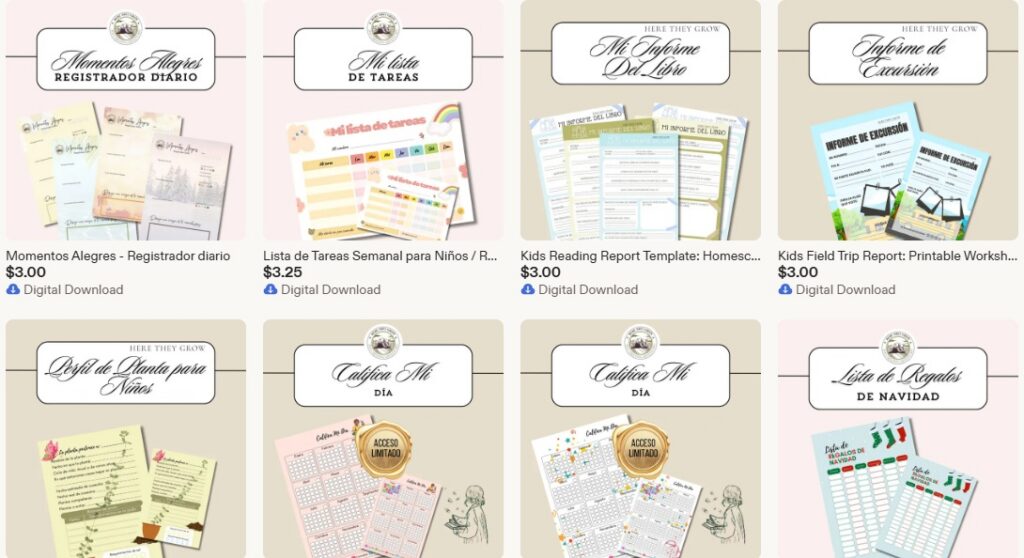
For families looking for Spanish activities and other child-friendly homeschool resources, the Here They Grow Etsy shop has printable downloads that can support learning at home in a simple, beautiful way.
Spanish Activities and Homeschool Printables
Browse printable Spanish activities, reports, lists, and learning tools that can support homeschool routines, language practice, and independent work.
Latin Is Still All Around Us
Latin is often called a dead language, but it does not feel particularly absent once you start looking for it.
It is in the names of birds and plants. It appears throughout science, medicine, law, and theology. It is tucked inside thousands of English words and sits behind entire modern languages. For Catholics, it is also woven through centuries of the language, music, and history of the Church.
That is what makes me excited to begin. Latin is one subject on our schedule, but I have a feeling we are going to start recognizing pieces of it in quite a few other places. And as with so many things in our homeschool, I suspect the children will learn more than I originally expected.
If you enjoy reading about the ways subjects connect across family life and education, you may also like why our son trains in three martial arts and how different experiences can enrich a child’s learning in unexpected ways.
Frequently Asked Questions
FAQ About First Form Latin in Our Homeschool
How much time does First Form Latin take each week?
Claire attends a one-hour group Latin class with a teacher each week. She also receives about six pages of homework per week, which currently takes her around three hours to complete. Another child may move through it much faster or need more time.
Can a fourth grader do First Form Latin independently?
Not independently, at least not in our experience. Claire is in fourth grade and still needs my help with the homework. She finds the material quite challenging, but she is catching on and enjoys those moments when it begins to make sense.
Does studying Latin alongside other languages cause confusion?
Not for Claire. She is also learning Spanish and ASL, and studying several languages seems to have made her more curious about them. She has even asked to begin learning French. That may be a passing interest, so time will tell whether we add it.
Ashley @ Here They Grow
You May Also Like:
 Weekly Wellness Challenge: One-Foot Balance
 How We Celebrate October as a Family Before the Holiday Rush
 Why Our Son Trains in Karate, Taekwondo and Brazilian Jiu Jitsu
 Camp Made Me Realize Something About Public School Moms (and Myself)
 Weekly Challenge #31: Say “Thank You” at Least Three Times a Day
 The Best-Friend Lens: A Simple Tool for Purposeful, Family-Centered Parenting
 Week 30 Family Challenge: Name Your Thoughts
 Raising Communicators: Why We’re Prioritizing Language in Our Homeschool