Why Our Son Trains in Karate, Taekwondo and Brazilian Jiu Jitsu
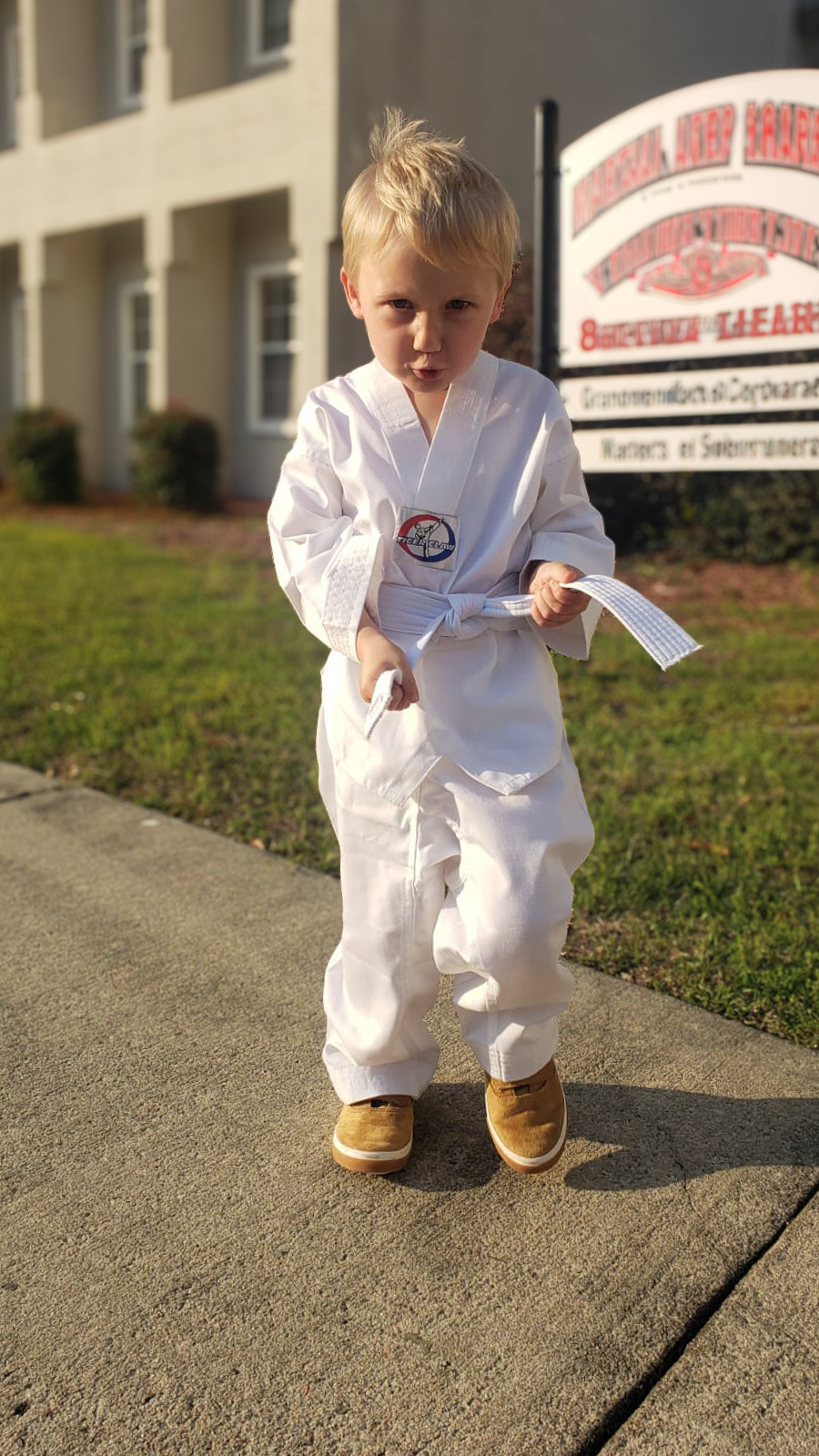
Homeschooling, character, and extracurricular learning
Why Our Son Trains in Karate, Taekwondo and Brazilian Jiu Jitsu
A reflection on martial arts, discipline, confidence, cross-training, cultural learning, and why these lessons matter far beyond self-defense.
In this post
Table of Contents
- Benefits Beyond Self Defense
- Three Martial Arts From Three Traditions
- Is It Like Learning Multiple Languages?
- Martial Arts Introduces Another Language
- Cross Training as a Homeschool Mom
- Martial Arts in Motion
- Martial Arts as Lifelong Fitness
- More Martial Arts We’d Like Him to Experience
- What I Hope He Takes With Him
- Related Posts
- FAQ
When people find out that our son takes karate, taekwondo and Brazilian jiu jitsu, I’m sometimes asked why we have him in three martial arts.
The simplest answer is that he loves it. He loves to punch, kick, fight and wrestle. He has loved that kind of physical play since he was tiny, and martial arts gives him a place to use all of that energy while learning how to control it.
At this stage, I’m much less concerned with how well he can execute a particular kick or submission than I am with what happens to him while he’s learning it. I want him to learn how to work hard, develop humility, listen to someone who knows more than he does, handle setbacks and keep improving.
That’s the foundation we’re really after.
The Benefits of Martial Arts for Kids Go Beyond Self Defense
Of course, I want my son to be able to protect himself. That’s a valuable skill.
Still, self defense is only one piece of what keeps us coming back.
Martial arts asks children to do things that aren’t always comfortable. They have to listen closely. They have to repeat something they haven’t mastered. They have to accept correction. Sometimes they lose. Sometimes another student is faster or stronger. Sometimes they work hard and still don’t get the belt, stripe or technique as quickly as they hoped.
Then they come back to class and try again.
That’s an awfully good lesson to learn when you’re young.
Confidence matters to me, but I want the kind that comes from competence and perseverance. I don’t want confidence that requires a child to believe he’s the best person in the room. I want him to know that he can walk into a room, listen, learn, work and eventually get better.
That is very close to the kind of confidence I wrote about in What Healthy Confidence Actually Looks Like. Real confidence is not fragile, loud, or performative. It grows through competence, effort, correction, and repeated practice.
Three Martial Arts From Three Different Traditions
Part of what makes this combination so interesting to me is that our son isn’t simply taking three versions of the same thing. He’s being introduced to martial arts that developed in different places and traditions.
Karate
His karate is Zen Shotokai, a karate tradition with Japanese and Okinawan roots and terminology. Karate itself developed largely in Okinawa before becoming established in mainland Japan. Traditional karate places a strong emphasis on disciplined practice, precise technique, stances, striking and forms.
Taekwondo
His taekwondo is Olympic style taekwondo, a Korean martial art and modern combat sport. It is especially recognizable for its fast, athletic kicking, footwork, balance and flexibility. Olympic style training also gives him experience with the pace and rules of a competitive sport.
Brazilian Jiu Jitsu
Brazilian jiu jitsu comes from yet another tradition. It has roots in Japanese jujutsu and judo but developed into its own martial art in Brazil. It brings him into a completely different world of grappling, leverage, positioning and ground work.
I especially appreciate the problem solving involved in jiu jitsu. Another person isn’t simply standing there while you demonstrate what you’ve learned. Your partner is thinking and responding too. You have to recognize what’s happening, adjust and figure out what to do next.
That kind of problem-solving is one of the reasons martial arts fits so naturally into our homeschool life. It reminds me of the same values I wrote about in Homeschooling Problem-Solving: Nurturing Resilient, Confident Kids.
Karate asks for precision and control.
Taekwondo develops speed, kicking, balance, and athletic movement.
Jiu jitsu asks him to grapple, problem solve, and stay composed.
Each discipline teaches his mind and body in a different way.
That variety is part of the point.
Is Learning Multiple Martial Arts Like Learning Multiple Languages?
This is where my perspective as both his mother and homeschool teacher comes into play.
Some martial arts schools prefer that students train exclusively in one system, particularly when they’re beginners. Different martial arts use different terminology, techniques, stances, rules and expectations, and some instructors believe learning more than one at a time will interfere with a student’s progress.
I understand the concern. I simply haven’t found it to be true for my son.
In fact, the closest comparison I can think of is learning multiple languages.
If a child is learning English and Spanish, we don’t assume that the existence of two words for the same object makes the child incapable of understanding either language. With instruction and exposure, the child begins to understand context.
The differences go much deeper than vocabulary. A person who speaks several languages well learns that pronunciation changes, sentence structure changes, certain sounds change and even the rhythm of speech can change.
The learner isn’t necessarily confused by those differences. Recognizing and applying them is part of learning the language.
That’s very much what I’ve watched happen with martial arts.
Our son knows when he’s in karate. He understands when he’s in Olympic style taekwondo. He walks into Brazilian jiu jitsu and knows that he’s working within another discipline altogether.
The stance may change. The terminology may change. What his instructor wants from him may change. Something appropriate in one setting may not even be useful in another.
He adjusts.
To me, that’s not evidence that children should learn only one system. It’s evidence of how capable children can be of learning context.
Martial Arts Really Does Introduce Another Language
The comparison to learning languages isn’t entirely figurative. One of the unexpected benefits of training in martial arts from different traditions is that children begin picking up pieces of the languages connected with them.
In karate, our son has learned to count in Japanese and hears words such as sensei for teacher, dojo for the place where you train, rei for bow and kata for a practiced sequence of movements. Even counting ichi, ni, san becomes familiar simply because he hears and uses it regularly.
His Olympic style taekwondo introduces Korean. He hears commands such as charyeot for attention, kyungnae for bow and joonbi for ready, along with Korean counting such as hana, dul, set. These aren’t words we’re sitting down and memorizing from a vocabulary list at home. They’re words that have meaning because he’s physically responding to them.
Brazilian jiu jitsu comes from another cultural and linguistic tradition. Many American BJJ schools use a great deal of English, but the sport’s development in Brazil means Portuguese terms and names are part of its larger culture. Words such as faixa for belt and raspagem for sweep are examples a student may encounter as he goes deeper into the discipline.
I don’t expect martial arts class to make him fluent in Japanese, Korean or Portuguese. That’s not the point. What I love is that a physical activity can stir up an interest in another language and culture almost incidentally.
That reminds me of why we value learning beyond worksheets and textbooks. Homeschooling gives us the flexibility to notice how real-life experiences support education, which is something I also shared in How Extracurriculars Can Support Homeschool Subjects and Learning.
For a child, I think there’s something particularly valuable about discovering that the world doesn’t always use the same words, customs or ways of doing things that we do. He learns the vocabulary that belongs to the room he’s standing in and then switches naturally when he walks into the next one.
He’s learning to tell the difference.
What Cross Training Has Taught Me as a Homeschool Mom
Watching this has influenced the way I think about education.
We sometimes underestimate a child’s ability to hold several systems of knowledge at once.
Children do it constantly.
They learn that a letter can make more than one sound. They learn that numbers behave differently depending on the operation. They can study another language with different vocabulary and grammar. A child who studies more than one musical instrument learns that techniques may transfer in some places and differ completely in others.
The goal isn’t to eliminate every difference so a child never has to sort anything out.
Learning to sort it out is valuable in itself.
When my son walks into three different martial arts classes, he has to pay attention to where he is, listen to the instructor in front of him, recognize what that particular discipline requires and respond accordingly.
He’s practicing observation, memory, adaptability and mental flexibility at the same time that he’s practicing punches, kicks or grappling.
As his homeschool teacher, I find that every bit as interesting as the physical training.
This is also one of the reasons I appreciate a contribution-focused childhood. Children need real places to practice responsibility, humility, listening, and effort. Martial arts gives our son one of those places.
A glimpse of the practice
Martial Arts in Motion
One of the things I appreciate most is watching how movement, focus, repetition, and control come together over time. The physical practice gives him a real place to work on the same character lessons we care about at home.
Martial Arts as Lifelong Fitness
There is another practical reason martial arts appeals to our family. We’re not particularly drawn to team sports.
That’s certainly not a criticism of them. Team sports can be wonderful for children, and they teach their own valuable lessons.
They simply aren’t the best fit for every family or every child.
One thing I especially like about martial arts is that the activity doesn’t have to disappear when childhood ends.
You don’t necessarily need to assemble a team, join a league or find ten other people who are available at the same time. Martial arts can remain an individual pursuit throughout adulthood, even though much of the training is naturally done with instructors and training partners.
- At 17, it can be about learning, challenging yourself and seeing how far you can progress.
- At 40, it can be exercise, a way to stay strong, flexible and active while doing something you actually enjoy.
- At 70, with the right modifications, it can help maintain muscle strength, balance, mobility and range of motion.
The practice may change as you do, but you don’t necessarily have to leave it behind.
We’re not simply looking for something to keep our son busy during childhood. I’d much rather introduce him to forms of movement that he may still value decades from now.
Helpful Gear for Active Kids
If your family is building simple routines around movement, discipline, or physical activity, this Amazon item may be useful: view the recommended item on Amazon.
There Are Still More Martial Arts We’d Like Him to Experience
Kung fu is one martial art I would love for him to experience if we eventually have access to the right program and instructor.
I’m not interested in collecting martial arts simply for the sake of saying he’s tried them. A good instructor matters enormously, and so does the environment in which a child is learning.
What interests me is exposure.
Different martial arts carry different histories, philosophies, traditions and approaches to movement. Just as I see value in exposing a child to languages, music, literature and ideas beyond the ones he encounters every day, I see value in allowing him to experience different martial arts traditions.
That is also why the culture around children’s activities matters so much. A good activity is not only about the skill being taught. It is also about the environment, expectations, adults, peers, and values surrounding the child. I wrote more about that in The Culture of Children’s Programs.
He may eventually narrow his focus. He may continue cross training. That’s something we’ll figure out as he gets older.
For now, I don’t see three martial arts competing for space in his education. I see three different disciplines teaching him how to use his mind and body in three different ways.
What I Really Hope He Takes With Him
If my son becomes an accomplished martial artist someday, I’ll be proud of him.
That isn’t really the measure I’m using right now.
Right now, I’m watching the little things.
Can he take correction without falling apart?
Can he lose and come back?
Can he listen when he’d rather be moving?
Can he respect an instructor?
Can he work on something that doesn’t come easily?
Can he be strong without needing to prove he is stronger?
Those lessons matter to me far more than how high he can kick.
Someday he may forget a particular kata or technique. He may move away from one martial art and become passionate about another. What I hope stays with him is the foundation underneath all of it: a willingness to work, humility in learning, resilience when something is difficult and the habit of continuing to improve.
Those are qualities he’ll need long after he leaves the dojo.
That kind of long-term character formation is one of the reasons we care so much about nurturing work ethic in our kids and building a family culture of love and hard work.
Shop & Connect
Explore family-centered printables, resources, and tools that support intentional parenting, homeschool rhythms, responsibility, and family connection.
Ashley @ Here They Grow
Frequently Asked Questions
Questions Families Often Ask About Training in Three Martial Arts
One of the questions we hear most often is how three martial arts actually fit into everyday family life. Here is what the schedule, cost, and decision-making look like for us right now.
How do you fit three martial arts into your week?
All three programs are paid monthly, and we choose how often we attend. If we’re on vacation or need a day or two off, we simply take it.
Taekwondo is offered four days a week, but we think of it as three days, with the fourth available for making up missed time. After a vacation, we might attend all four. Another week, we might only make it twice, and that’s fine too. Karate meets once a week, and jiu jitsu meets twice. We decide what we can attend week by week.
How much do three martial arts cost each month?
We pay $290 a month for Peter’s three programs. Claire takes only jiu jitsu, which costs an additional $50 a month at the school’s sibling rate.
Did Peter start all three martial arts at once?
No. Peter enjoyed taekwondo enough that we decided to add karate. That felt doable because karate was only one day a week.
Jiu jitsu came into the picture through his sister, Claire. She wasn’t interested in taekwondo or karate, but she wanted to try jiu jitsu. Peter’s response was essentially, “Hey, I want to do that too!” Those classes meet twice a week, and both children participate.
How do you know whether the schedule is working for him?
Peter really enjoys martial arts and is usually excited to go. It’s his gym class and his physical education, and the classes include a mix of instruction, movement, practice, and games.
In jiu jitsu, for example, they warm up, watch a technique being demonstrated, practice it, receive more instruction, and do a couple of short rounds of sparring. One warm-up game involves running across the room while dodging balls. If they get hit, they do an exercise, such as jumping jacks or a handstand against the wall. The kids love it.
He rarely asks to skip, maybe a couple of classes a month, so when he does, we listen. Sometimes we agree that a night off would be good. Other times, especially if we’ve already missed classes, we encourage him to rally and go. Learning to make an effort when you don’t feel like it matters too. So far, he has never told us afterward that he wished he had stayed home.
His opinion carries weight in that decision. We know how much he normally enjoys going, so an occasional request for a break deserves consideration. We want him to respect our guidance and know that we respect what he has to say.
You May Also Like:
 Why We Leave Our Shoes at the Door: A Simple Family Routine That Works
 A Love Letter to My Children
 How We Celebrate October as a Family Before the Holiday Rush
 Why We’re Beginning Latin in Our Homeschool
 Weekly Wellness Challenge: One-Foot Balance
 Camp Made Me Realize Something About Public School Moms (and Myself)
 Weekly Challenge #31: Say “Thank You” at Least Three Times a Day
 Week 30 Family Challenge: Name Your Thoughts